
Back to Archives
Collumn 2
The Possibilities of Collective Kannō
The fieldwork group arrived in the Kuroda settlement by microbus and quietly made their way up the slope leading to the Kannondō Hall of Kuroda Annenji Temple. Here in Kuroda, a Kannon statue—known as Imo Kannon (いも観音, Potato Kannon)—is enshrined. Hidden underground during the turmoil of the Warring States period, the statue has lost much of its original form. The path to the hall is narrow, flanked by towering cedar trees, and the group proceeded toward the small structure at the end of the approach.

The path leading to the Kannondō Hall of Kuroda Annenji Temple, visited during the Nagahama fieldwork.
One of the highlights of the Nagahama fieldwork was this visit to the Kannondō (観音堂, Kannon temple hall). I was born and raised in a nearby village, surrounded by premodern cultural traditions such as this temple hall until I finished high school. Even after moving to Tokyo, I would occasionally return with friends to visit the site. Yet when I gathered before the hall with dozens of fieldwork participants this time, I sensed something distinctly different.
The feeling of visiting alone—or in a small group—was clearly unlike the experience of arriving as a collective of several dozen people. The small hall could not accommodate everyone at once, so the group divided into two and entered in turns. Some listened to the guide inside, contemplating the altered and, from certain perspectives, almost painful figure of Imo Kannon. Others remained outside, enveloped by dappled light filtering through the trees and the subtle movement of wind in the forest canopy. Before my eyes unfolded a scene that could be described as collective sensing—a group resonating together with the space and time generated by a single place.

At Kuroda Annenji Kannondō, with guide Tsushima offering an explanation.
At the beginning of The Forgotten Japanese by the folklorist Tsuneichi Miyamoto, there is a story of an elder who, when asked to show an old document preserved in his village, replied that the matter would be decided through communal discussion. In premodern Japanese villages, collective decision-making through such gatherings was commonplace.
In the Nagahama region of Shiga Prefecture—this fieldwork’s site—there remains an annual Shinto ritual known as okonai. On a designated day each February, household representatives gather in one place to perform the ritual. It is also an occasion to share time, to sense together, and to strengthen communal bonds. Here too, collective resonance is enacted as a formal practice.
This fieldwork employed a method called kannō (感応, to sense-feel and respond), drawing from visual and sensory ethnography, participatory design, and Confucian thought. It seemed that this approach unfolded its full potential through a form of collectivity cultivated by our premodern predecessors. The participant roles of Maker, Watcher, and Asker functioned as devices enabling collective resonance. Roles are equally vital in village rituals like okonai (おこない, ritual practice) ; by fulfilling assigned roles, participants carry forward ritual forms that connect past and future.
Another key approach in the fieldwork was the distinction between Chronos and Kairos. Rather than privileging the absolute clock-time emblematic of modernity (Chronos), emphasis was placed on plural, relational time (Kairos). While modernity foregrounds the rational individual, this fieldwork seemed to enact a premodern mode of subjectivity—resonating through relational roles within a collective.
What, then, is the significance of such collectively constituted subjectivity in circular design? The linear economy—contrasted with the circular economy—rests on the modern industrial logic of extracting resources, producing goods, consuming them, and discarding them. Circular design instead calls for systems thinking that sees the world as a constellation of plural existences. The premodern subjectivity glimpsed in this fieldwork offers valuable insight here. By sharing place and time collectively, and engaging the world through assigned roles, collective resonance becomes possible. This was one of the fieldwork’s key achievements.
In Kyoto, participants transformed what they had collectively seen and heard into a shared booklet. Rather than accumulating experience individually, they expressed collective sensing as collective output—an approach that may be understood as a critique of modern individualism. Such outputs carry plural meanings and invite further collective resonance in those who encounter them.
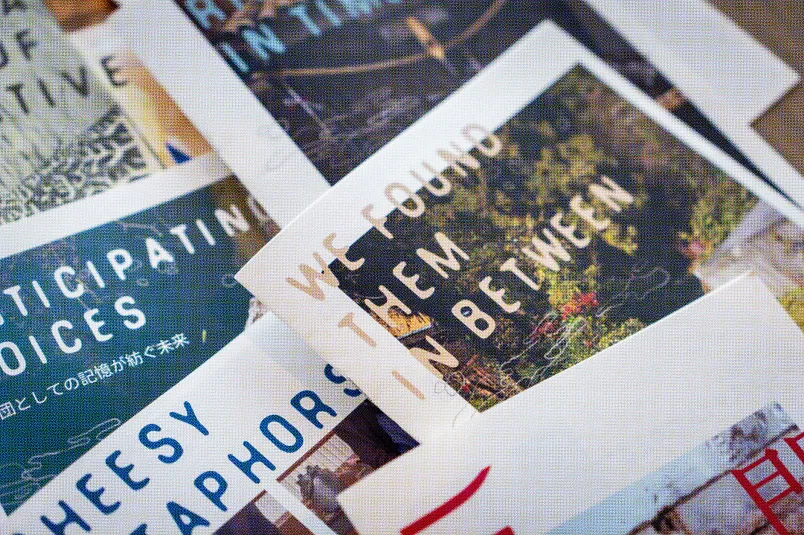
Booklets created during the Day 3 workshop in Kyoto.
Having grown up in Nagahama—where traces of the premodern remain vivid—and spent my adult years in Tokyo’s modern industrial society, I have long felt the strangeness of these two worlds coexisting in Japan. Would premodern society be entirely displaced by modern rationalism? Was there a way to reconcile the two? Moving between these worlds, I have continually carried this question.
Through CDW, I felt a glimmer of light on this question. Rather than viewing the Nagahama field through the lens of the modern individual, resonating through collective subjectivity—and expressing it in outputs open to plural interpretation—suggested a possible integration of these worlds. That this practice connected to circular design, an effort to mend the errors of industrial society, was one of the fieldwork’s most significant outcomes.
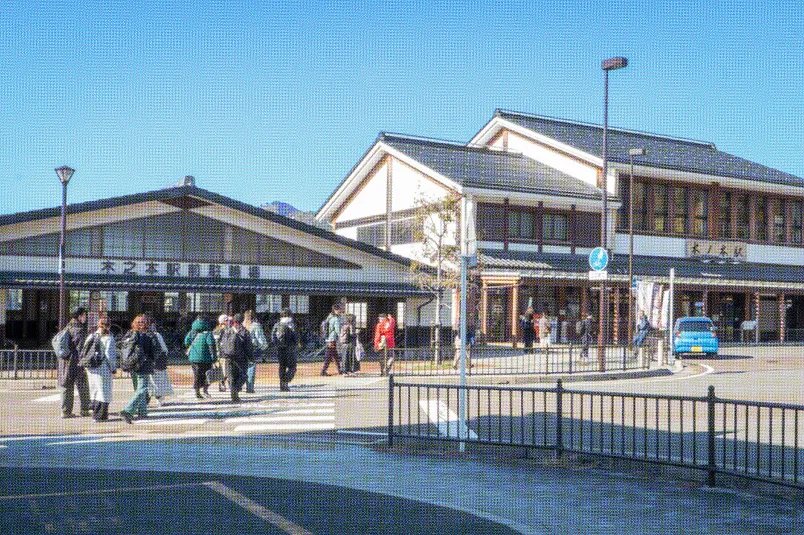
Kinomoto Station in Nagahama, the starting point of Day 2 fieldwork.
Further Reading
-
Ingold, T. (2015). The life of lines. Routledge.
-
Miyamoto, T. (1984). 忘れられた日本人 [The forgotten Japanese]. Iwanami Shoten. (Original work published 1960)
-
Pink, S. (2015). Doing sensory ethnography (2nd ed.). SAGE Publications.